Jo inherits Plumfield and founds a school
Little WomenJo inherits Plumfield and founds a school there, converting an unexpected inheritance into a home and educational community for boys who need instruction, care, and kindness. The decisive significance of the action lies in its transformation of private property into shared usefulness: Plumfield does not become a source of fashionable wealth, but the material basis for the life Jo has imagined since youth, one in which work, affection, discipline, and social responsibility reinforce one another.
Inheritance and the Long-Prepared Plan
Aunt March's sudden death initially brings renewed grief to the family, who had loved her despite her sharp tongue. The loss is followed by a discovery that changes Jo's prospects: Aunt March has left Plumfield to her. Laurie assumes that Jo will sell the substantial old property, which would bring a handsome sum, but Jo refuses. Her decision establishes that the inheritance will be treated not as disposable capital but as a place with a purpose.
The school is not an improvisation produced solely by the inheritance. Jo explains that it has been a long-cherished plan. Before Friedrich Bhaer entered her life, she imagined that once she had made a fortune and was no longer needed at home, she would rent a large house, gather poor and motherless boys, care for them, and make their lives happier before neglect could ruin them. She has observed boys going astray because help did not reach them at the right moment, and she describes an unusually strong sympathy with their needs and troubles. The inheritance therefore supplies the means for an intention that had already grown out of Jo's characteristic impulse to act, protect, and make life more energetic.
Designing the School at Plumfield
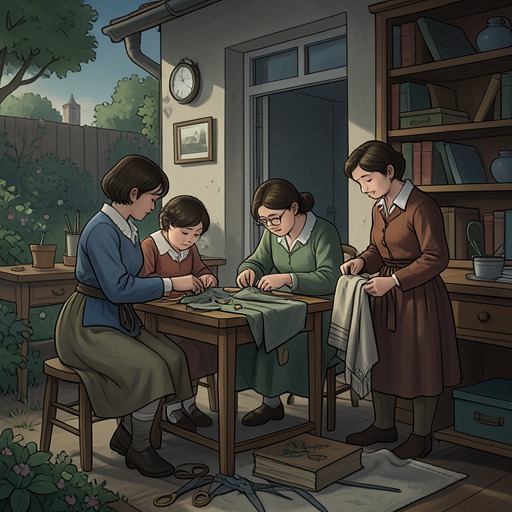
Jo proposes a school for little lads that will be good, happy, and homelike, with herself caring for the children and Friedrich teaching them. Plumfield seems suited to this purpose because the house is large, its furniture is sturdy and plain, and its grounds provide room for many pupils as well as useful outdoor work. The boys can help in the garden and orchard, while Friedrich can train and teach in his own way; Mr. March is expected to assist him, and Mrs. March will serve as Jo's support.
The plan combines education with domestic care rather than separating the two. Jo imagines herself feeding, nursing, petting, and scolding the boys, and she speaks of wanting to be a mother to them. Friedrich has already spent his life helping poor boys, even though he has never accumulated money because it does not remain in his pocket long enough to save. Their partnership consequently joins complementary resources: Aunt March's property, Jo's organizing and maternal energy, Friedrich's teaching and charitable practice, and the March family's willingness to support the undertaking.
From Estate to Community
The transformation occurs rapidly. Jo marries Friedrich and settles at Plumfield, after which six or seven boys soon form the beginning of the school. Mr. Laurence repeatedly discovers cases of destitution and urges the Bhaers to take in the children, offering to pay a little toward their support. His assistance allows the school to receive precisely the kind of disadvantaged boys in whom Jo takes the greatest interest.
The early work is difficult. Jo makes awkward mistakes, while Friedrich guides her toward steadier methods, and the most unruly boys eventually yield to the combined patience and authority of the household. The former estate becomes crowded and active: every room fills, each garden plot acquires an owner, and the barn and shed develop into a menagerie because the children are permitted to keep pet animals. The contrast with the house's earlier identity is central to the action. Plumfield is no longer a private, prim, well-ordered domain; it is overrun by boys who eat forbidden plums, disturb the gravel, and play cricket in the large field.
Laurie jokingly suggests the name "Bhaer-garten," a pun suited to the place and its inhabitants. The nickname captures the school's mixture of education, cultivation, and exuberant disorder. What had been inherited as a fixed estate becomes a living institution whose physical spaces are continually claimed, used, and reshaped by its pupils.
Method, Discipline, and Care
Plumfield never becomes a fashionable school, and Friedrich does not use it to build a fortune. Its success is measured by fidelity to Jo's original purpose: it is a happy, homelike place for boys who need teaching, care, and kindness. The school is therefore structured less around status than around relationship. Its pupils include slow and bashful boys, feeble and riotous boys, children who lisp or stutter, lame boys, and a merry little quadroon whom other institutions would not accept. Some people predict that admitting him will ruin the school, but Plumfield welcomes him, making inclusion part of its practical identity rather than an abstract principle.
The adults' authority depends on more than punishment. Jo believes that even the naughtiest and most troublesome boy contains a good spot, and this conviction gives her the patience and skill to persist. Friedrich's benevolent influence and Jo's readiness to forgive eventually overcome resistance. The boys' penitential whispers, confidential disclosures, enthusiasms, hopes, plans, and misfortunes become precious to Jo because wrongdoing and vulnerability deepen rather than cancel her attachment to them. Care is thus both emotional labor and an educational method: the boys are corrected within a relationship that assumes their capacity for improvement.
Meaning and Lasting Consequences
The school gives Jo a form of independence different from the solitary literary ambition that once defined her. Earlier, she worked to support herself and help her sisters, earning money through stories and discovering the satisfaction of supplying the household's needs. At Plumfield, however, her labor is no longer directed chiefly toward publication or worldly fame. She tells stories to her pupils, and their admiration becomes more satisfying than public praise. The inheritance makes possible a vocation in which writing, domestic work, teaching, nursing, and moral formation are gathered into one communal life.
Jo's happiness at Plumfield does not depend on the absence of difficulty. The school requires hard work, creates anxiety, and produces a perpetual racket; the boys are not angels, and some cause serious trouble. Yet Jo finds the work deeply fulfilling because its rewards are immediate and relational. She sees affection returned in grateful looks and trusting words, while her faith in each child's latent goodness gradually produces patience and success.
The institution also expands into a family. Two sons, Rob and Teddy, are born to Jo and Friedrich, and they grow up among the larger company of boys, whose rough care helps sustain them. Plumfield therefore fulfills Jo's desire for both a family and a social mission: it is at once a home, a school, a refuge, and a practical expression of her belief that neglected children can be changed when someone helps them at the right moment. By refusing to sell Plumfield, Jo turns inheritance into continuity, and by founding the school she converts personal happiness into a durable benefit for others.